So here's the idea...

So here's the idea...

This blog is the beginning of an experiment. I've been working idly on the fantasy world of Maeleff for a few months, typing on my phone during subway rides, and I think I may have the beginnings of something here. However, I'm lazy and bad at following through with things, so I'd like help.

Specifically, I'd like to turn this idea into an open world fictional universe. My friends and creative folk will be invited to peruse the information I have on the world, and to play with it. Write characters. Write stories. Add races, city-states, monsters and ancient ruins. I'd like to write stories, role play, and generally allow my friends to help me explore and create a rich, if someone forbidding, fantasy world.

Tuesday, January 29, 2013

Personnel with the Office of Causal Whatever I Called It


Oversight. Causal Oversight. That's it.

Racine Zed
Human female, 70 years old. Long and varied career, including merchant, smuggler, pirate, fence, and for the last 30 years, the captain of the Nails.
Tall (though getting a bit bent now with age), and still deceptively tough. Gray hair, hazel eyes. Still strong, though fighting off a bit of a gut. You can tell that she was once mildly pretty, if not outstandingly so, still has a very commanding presence.
Sarcastic sense of humor. Wickedly smart. Good with secrets, and nobody can be said to know all or even most of the projects and agents she is running at any point in time.
Tinkered with a bit of alchemy in the past, but has avoided the Blood.
Commands great respect from her people, who also (very reasonably) fear her.
Two husbands plus a Sava lover, three children, seven grandchildren. Has apartments within the trade quarter, as well as a modest estate outside the city walls.


Kepli Thikt Sen
Male Shar, Blooded Mage, and a close advisor to Zed, who is the only person in the Office who is aware that he is blooded. String willed, he has so far avoided any physical changes from the Blood, but it had started to affect his mind. Friends have noted that he is getting more paranoid and insular. Small, with blue and black stripes.

Taen Shalun Marithire Ru'Halena ma Sheer (Tall red blossom in the outer reaches of the high forest)
Called "Taen" by most non-Aelth, or "Red" by friends.
Female Aelth, former scout and mercenary with a Traveller's Society, joined customs and the Office about ten years ago, recruited by Zed. Thin, deep yellow skin, red hair and eyes

Monday, January 28, 2013

Landscape feature - Craters


Giant craters, leftover from the gods' wars, that breach huge networks of tunnels, and all kinds of strangeness.  Come up with a suitably dramatic name

The craters make up a significant portion of the landscape.

In the time since the gods died, natural weathering and growth have started to change the landscape. Plantlife begins to reclaim the blasted lands.  The huge craters that broke open underground cities and networks of ancient tunnels have turned into cities reminiscent of Native American pueblos.  The great Geb city of (whatever it's called) is one example.

More on the death of the gods

The virus (for lack if a better term) that destroyed the gods was not of this world.  It was found in the outer reaches of the universe  by one forgotten god, modified and unleashed.

The virus was inimical to the stuff that the gods were made of. Not matter per se, as the gods were never truly material in the way we think of it, but they did have a real substance to them. Not anymore, they were utterly unmade.

The virus' effect on other things is less predictable.  Magic is similar to the power of the gods, but not identical.  Thus magic carries the virus, but is not destroyed by it.  In fact, the virus itself being made up of an incredibly powerful and strange energy, magic was in many ways made stronger, if far more dangerous.

As for mortal flesh, life on this world was altered drastically by the gods, and infused with a portion of their power and essence. Thus, the virus is almost always  inimical to it. But unlike the gods, who were helpless before it, mortals are made of different stuff that gives them strengths and options that the gods did not have.  Thus usually they are unmade, but sometimes they are only changed.

Work on making Blood-touched mutations and changes more Lovecraftian in tone than straight up undeath, at least in its greater forms.

I keep thinking I should come up with names for this stuff - the blood, the virus, the dead gods, etc.   But I kind of like having the stuff unnamed.  The names of the gods have been deliberately forgotten.  Nobody understands the virus or even know it exists really, so it just the blood as far as they know.

Time Line

I guess I have to decide once and for all how long it has been since the gods died.  I've been somewhat inconsistent over the course of my writing.

I've been vacillating between 1000's of years and just a few.  I think I need to sort of split the difference and make it a several hundred years, maybe between 500 and 800. I want enough time for society to rebuild in a new image, and for a lot of knowledge to be lost, but not all of it, with new technology/magic to be derived from the remnants of the old.  This also makes it long enough for archaeology to be a significant factor in the rediscovery of old knowledge and power.

So there was a bit of an apocalypse maybe 600 or so years ago. Civilization survived in isolated pockets until about 100 to 150 years ago, when isolated populations started to reconnect with each other.

That's not to say that those isolated populations had been idle all that time.  Ammadhur for example has been growing steadily for the entire period, exploring the ravaged world and starting to reconnect with whomever they could find.

There are some groups that have banded together - by choice, conquest, or whatever - into budding nations. But most of the world - or at least of this continent - remain smaller city-states, some like Ammadhur with areas around them that depend on the city for any number of things, like unofficial de facto nations.

Wednesday, January 16, 2013

Not with a bang...

The virus (for lack if a better term) that destroyed the gods was not of this world. It was found in the outer reaches of the universe by one forgotten god, and unleashed.

The virus was inimical to the stuff that the gods were made of. Not matter per se, as the gods were never truly material in the way we think of it, but they did have a real substance to them. Not anymore, they were utterly unmade.

The virus' effect on other things is less predictable. Magic is similar to the power of the gods, but not identical. Thus magic carries the virus, but is not destroyed by it. In fact, the virus itself being made up of an incredibly powerful and strange energy, magic was in many ways made stronger, if far more dangerous.

As for mortal flesh, life on this world was altered drastically by the gods, an infused with a portion of their power. Thus, the virus is almost always deadly to mortals that encounter it. But unlike the gods, who were helpless before it, mortals are made of different stuff that gives them strengths and options that the gods did not have. Thus usually they are unmade, but sometimes they are only changed.

Work on making Blood-touched mutations and changes more Lovecraftian in tone than straight up undeath, at least in its greater forms.

I keep thinking I should come up with names for this stuff - the blood, the virus, the dead gods, etc. But I kind of like having the stuff unnamed. The names of the gods have been deliberately forgotten. Nobody understands the virus or even know it exists really, so it just the blood as far as they know.

Sunday, January 6, 2013

Shar city

Found this picture of a town in Buenos Aires that was underwater for 25 years after a dam broke, and is now being revealed again. I'd like to use this as the basis for the map of a Shar city.

Friday, January 4, 2013

The Office of Causal Oversight

Ammadhur's legal system, like every other aspect of its governance, is an immensely complicated tangle of rights, duties, obligations and spheres of influence. The guild of barristers is quite powerful as a result.

The city being a central port and hub of mercantile activity, the role of the customs office is extremely important, and they are universally given a surprising amount of leeway in the legal system. Some time ago, a smart Tyrant took advantage of this by creating a small cadre of the customs police whose job was ostensibly to investigate corruption at the highest levels, and who were answerable to nobody but the Tyrant himself. He then manipulated changes in several bodies of law to make sure that certain holes were left unfilled, and which resulted in the group having no charter to speak of, and few if any legal limits on their powers.

That group has the innocuous title of The Office of Causal Oversight, but are referred to by most as "The Nails", for reasons lost to history. In effect, they act as the Tyrant's own hounds and secret police. They recruit their numbers from many sources, not the least being Ammadhur's prisons, where any number of pirates and smugglers have found themselves shanghaied with the simple choice of service or death.

It is rumored that the Nails have dealings with the Blooded, possibly even with Blessed, and may harbor some within their numbers. They are suspected especially of having several Skinwalkers in their ranks.

Thursday, October 25, 2012

*chirp...chirp*

For the record, this project is not dead. It's been on hold during a lengthy hospitalization and recovery, but I'm starting to think about it again and hope to have some updates soon.
Cheers,
Chris

Friday, July 20, 2012

The old ways


"The world has abandoned the old ways. We have not. We  will be raised up, proven, when all else  fails."
"Proven to who? The gods are dead, the world is doomed by it. What ways?"
"They will return. We are being tested. We remain strong."
"You're mad. All geb are fucking mad and you'll doom us."

Monday, July 2, 2012

Ignore the names...

Living ships - controlled by a shipspouse. Left over from the days of the gods. Engineered from whales, semi-sentient, huge ships, originally warcraft but adapted to fast cargo hauling through rough and dangerous waters. Imagine a corrupted one..

In the days of war, some of the gods crafted certain enormous marine animals into living warships. Leviathans are something between a whale, a giant squid and an immense nautilus. The warships that were made from them are called Galleathans.
They are immense creatures the size of galleons, with decks covered by a transparent crystalline nautilus shell, and weapon ports covered by gill-like flaps. They lack any control schemata, instead each is mentally bound to a particular family of sentients. More specifically, they are bound to one person, and on the death or incapacity of that person the bond will pass to the most genetically similar person, usually a child. They can either be forced to obey, or trained to build a bond of trust and obey voluntarily. The Galleathans are relatively strong willed, so forcing obedience is difficult for most.

Pilots must be magically active and trained in order to create the bond in the first place, although they need not be trained to accept a bond passed from another. An untrained person who suddenly finds themselves bound to a Galleathans can actually be taught and trained by the beast itself

Because the nature of the bond is at its heart magical, the Galleathans may be corrupted through the bond to their pilots. Along the same lines, a corrupted ship whose pilot dies, whose bond then passes to another, will in turn corrupt that person.

Sava cannot be pilots, and cannot be bound by a Galleathans. In fact, Galleathans generally will not tolerate having a Sava on board, as their anti-magical field interferes with the bond and causes them pain.

Galleathans are affected by the will and personalities of their pilot. A pilot who is laid back, generally happy, and works with his ship rather than forcing obedience will generally have a playful, happy ship that may stretch its commands but will no seek to break the bond. A brooding, angry pilot who forces it's will on his ship will have an angry ship, difficult to control, that constantly seeks to break its bond or pervert it's pilot's intent.

Saturday, June 30, 2012

Quick idea to be expanded later...

Living ships - controlled by a shipspouse. Left over from the days of the gods. Engineered from whales, semi-sentient, huge ships, originally warcraft but adapted to fast cargo hauling through rough and dangerous waters. Imagine a corrupted one..

Monday, June 18, 2012

A meeting

A long vertical stone chimney, smooth walls, leading deep into the ground. At the bottom is a spherical chamber, the bottom third of which is filled with a pool of gods blood, a viscous red liquid so dark it is almost black, and which radiates a faint purple glow that illuminates nothing but the blood itself.

Hovering above it is a humanoid in hooded light saffron robes, sitting it a lotus position in mid air. The robes are stained with blood, also glowing faintly. Her blood occasionally drips into the pool, the only sound in the chamber. The chamber has a single other entrance, a hidden door leading to a narrow ledge high on the wall, facing the back of the floating figure.

A group of adventurers enters the chamber, tensely and silently. The figure pulls back it's hood to reveal the rent and eyeless face of a Weeping . The creature's split and bleeding lips turn gently up in a small, sad smile. It's lips do not open, but each member hears its beautiful and hypnotic voice directly in its mind, each in their native language. "Welcome, my children. You are weary. Please take your ease. Be warmed. Be one, and at peace." The four hardened treasure seekers feel their eyes start to close, their attention wandering and their bodies relaxing, while in each, the core of their beings wails first in fear, then in despair, then in ecstasy.

Wednesday, May 30, 2012

Ammadhur city sections


1) Scholar's Quarter - universities (private and public), Mage guilds, archaeological societies. Homes of wealthier scholars, mages and some wealthy families with academic pretensions.

2) trade quarter - docks, trade houses and merchant's guilds, League of Guilds meeting house, Customs House, guard house for League Watch. Many of the moderately powerful merchant families have homes here. Some residential neighborhoods, lower and middle class.

3) Tyrant's quarter - Tyrant's palace and wealthiest citizens, including estates for those powerful merchant families who do not choose to live outside the city walls. Guard houses for Tyrant's Watch.

4) government quarter - Great Council buildings, bureaucratic buildings, guard house for Council Watch. Some homes for council members and upper bureaucrats.

5) various residential areas. Middle class home and apartments, poor quarters and slums, multiple small racial ghettos/neighborhoods.


Just a note to myself: draft (or get someone to draft) a map of Ammadhur and it's environs, based on medieval Mantua.

The Khevan Vestments


A few scraps of half rotted cloth, named for the city in which they were found, and where they are being studied. The Vestments are believed to be portions of the ritual garments of a Geb priest-king from the age of the gods. Any Geb coming near them without powerful magical protections is filled with a powerful urge to touch them, but actually doing so causes immediate and powerful headaches in most and throws others into a coma. Non-Geb feel nothing, and oddly enough the Blooded also feel nothing from the scraps. They are kept ringed with protective circles in the University of Kheva Rhak and are being studied.

The Iron Word


An ancient Geb artifact, believed by many to be the item used by one or more of the Geb's gods to speak with and convey directions to their people. A fifty foot high tower composed of striated and seemingly random patterns of various metals fused somehow into a single piece with no visible seams. The top of the tower is ringed with large purple crystals inset into the metal, and irregular rays of the various metals used in its construction, resembling tree roots, spread out from its base. The tower has four circular openings, each about ten feet in diameter, spaces evenly around it, about five feet of of the ground. The openings lead to a single spherical chamber composed apparently of the same purple crystal as the stores around its crown. All of the crystals glow faintly, the brightness of the glow pulsing regularly in very slow intervals, each pulse taking about a week to complete under normal circumstances. The pulses speed up marginally if magic is used near the tower. Any attempt to use magic within the tower has proven to immediately infect the wizard with the blood of the gods.

The tower, which lies about 100 miles to the northwest of Ammadhur, is perpetually surrounded by mages and students of the Reevan School, a university of magic that has been studying it for centuries. They study the Word and keep strangers from entering it and possibly harming themselves and others. Despite hundreds of years of study, they have yet to definitively prove its purpose.

Wednesday, May 9, 2012

Another monster without a name. I'm bad at names.


Small, flying creatures with sharp features suggestive of a young aelth. They fly, and sing a strange, warbling song. Their song is psychoactive. Targeted creatures that hear the song will become fascinated by the creatures, hold them, pet them, and feel intense pleasure. with longer exposure, or exposure to multiple creatures' songs, victims will essentially freeze in place, paralyzed with ecstasy. At that point the singers will begin to feed, flaying strips of flesh and eating them. They feed in groups, but take their time.

Singers are roughly humanoid, about one foot high, with bat like wings. Their skin is silvery, with shimmer and highlights that range through a rainbow of colors. Enormous pearlescent eyes, tiny and viciously sharp teeth, and long razor-sharp claws. They nest in forests, in groups of a dozen or so.

Friday, May 4, 2012

Big fantasy tropes...

So I've been trying to sort of re-skin a lot of the standard fantasy tropes and give them an interesting (to me anyway) personality. So what to do, if anything about some of the bigger fantasy tropes?
And I mean that literally, BIG tropes, specifically giants and dragons.
A dragon equivalent would e way enough to explain - there was life on the world before the gods got there, there could easily have been a large, smart, dangerous, flying predator of some type. Easy enough to assume that some god or other tinkered with them, made them even bigger and smarter, and gave them access to magic. The latter would be necessary if the whatever was to be truly draconian in scope, as a creature that big would need magic to fly, at the very least.

But how to do it without just making a dragon, or something that screams "this is supposed to be a dragon, yet is kind of stupid"?
Wyvern would be easy enough to explain. Birds or local bird-like organisms that were boosted by the gods, or just mutated by exposure to the blood.
Maybe just have someone doodle something, and figure out what it is afterwards...

Monday, April 23, 2012

Just a random thought...

Magic is finite, the corruption is not. The well of magic was kept full by the gods, until their death. Now that they are no longer there to refill it, it is a limited resource, and will eventually run dry. It may take 1000's of years, maybe longer, but it will run out eventually. However, the corruption is alive and self-perpetuating. As long as there is life in the world, the Blood will be there, and will be a path to power. This eventually, all magic will be corrupt, and some time thereafter the entire world will succumb to the blood.

DOOMED! DOOMED I TELL YOU!

Don't know if I actually want to use this or not, just a thought...

Notes on the nature of magic and sacrifice

Though the gods made constant war on each other, up until fairly close to the end they were surprisingly civil as to how they went about it. They chose a battleground together, and they reached a mutual agreement about many of the tools and weapons they used, such as the well of magical power that they created for their worshippers to wield against each other.

Magic is a power source. Discounting the corruption that now festers in its depths, it is value neutral. It is a source of energy that was designed to react to the will and desire of its users, and to conform easily to structure imposed from outside. Thus, rituals used by those with a firm purpose in mind will draw power from the well and cause it to shape itself into different forms.

There are those that say that magic itself has a kind of sentience, a rudimentary intelligence that responds to and communicates with those that try and use it, that consciously shapes itself in conformance with the desires of the mages wielding it. This has never been widely accepted or proven, and if true, nobody knows what effect the corruption has had on that mind.

While there is no consensus as to whether or not magic is alive in and of itself, it is clear that magic reacts to life, and is tied to life force in some way. Natural plants and animals will draw up and store a small amount of magic by themselves, and can even use it in rudimentary ways. Thus shamanistic mages have found ways to use plants and animals as intermediaries between themselves and the raw force of magic, sacrifices of plants, animals and people can give access to a sudden burst of power, and natural ingredients can aid mages in the casting of their spells.

Some shaman have found ways to use sacrifices to place a barrier between themselves and the corruption at magic's heart, or at least they believe they have. The idea is to use another person or being to cast a spell through, allow the corruption to infest that person, and kill them at the height of the spell, this gaining both an extra boost of power and a filter for the corruption and it's effects.

Wednesday, April 18, 2012

Need to put a few new things together soon, here's a few notes:
- Lightbringers - they are to mages what the cherubim were to the gods. Beings of light created as servants, now mostly wild an corrupted.
- want a new race, something small and quick. Possibly an airborne race as well.
- need to describe the current Tyrant and a few others in the Ammadhur government
- need to add a second animals an beasts post, set out some domestic animals.

Wednesday, April 11, 2012

I need maps

I need some maps, and I can't draw for fuck all. I know Ammadhur should be visually based on Mantua in about the early 17th century, with guard towers along each bridge, and the bridges separating parts of the city. Don't have a clue what the surrounding landscape should look like. Would any of my lovely and talented friends like to help me create the geography of the world of Maeleff, and possibly draw me a map or two?

Monday, April 2, 2012

Cherubim/Blood Wisps

Called "blood wisps" by most, or "cherubim" by scholars that study the dead gods and their creations, these creatures are invisible and silent, and only semi material (to most). Only way to tell where it is is that anywhere it touches anything (including the ground) it leaves a bloodstain. It's blood is poisonous, but not a power source, having been extremely degenerated from the original source of its power.

They are degenerate forms of what amounted to angels, spirit servants of the gods. Originally they were pacifistic, body servants and sex slaves for the gods and their chosen servants. When the gods died, they were affected as well, being composed of something like the same stuff. But as they, like the servitor races, are only similar to the gods physically, rather than identical, their numbers were drastically reduced but not utterly destroyed.

The few that are left are somewhat inbred and highly aggressive, cunning rarher than truly intelligent, unlike their ancestors.

Visible and audible only to those that have been corrupted. To them, they appear as androgynous creatures of unearthly beauty, naked and alluring despite being covered in blood. To the uncorrupted their blood is a powerful poison, to the corrupted it is a powerful euphoric. The creatures seek to kill the uncorrupted and seduce the corrupted.

Tuesday, March 27, 2012

Animals and beasts (pt. 1)

Thisp
Mammalian snake like creature covered with "fur" which is really a symbiotic algae colony. The photosensitive algae colony provides chameleon like properties, shares it's photosynthesis with the animal when hunting is scarce, and shares the snake's caloric intake at night. The snake has a euphoric venom, which is in fact plant based. 2 - 3 feet in length, brown skin with a "fur" that changes color with the leaves.


Karr Hound
Quadrupedal mammal, powerfully built, 5 to 6 feet from nose to hindquarters, with a long tail.
Resembles a large, powerfully built hyaena in basic form, though longer of limb and with feet that resemble rudimentary hands. Hairless save for a strip of fur that runs down their backs. Climbing pack hunters that live in hilly and mountainous terrain.a

Need:
[swamp dragon]

[plains ape]

[desert cat]

Some thoughts on corruption in the natural world

Need to consider what effect the corruption has on the natural world.  The gods came to a world already full of life and merely modified some of it to fit their dneeds, so it's not like all life in the world was inextricably intertwined with them.  But I've established that there are "natural magics" so there must be some connection.

Shamanistic magic is a slow and gradual accumulation of power to subtly manipulate the natural world. As such it is relatively safe, much like alchemy and enchantment. But of course the corruption is insidious, and even the most careful use of power has the potential to become tainted. 

Occasionally, in areas where a lot of magic directed at the natural world has been practiced, a thread of corruption will affect a plant or animal. Usually, this ultimately leads to blighted areas devoid of life and radiating sickness. Every now and then, the plant, creature or area is merely changed, warped and mutated.  This is how rothounds are created, but they are not the only such creature. 

When entire areas are so affected, becoming twisted and corrupt parodies of nature, they are often inhabited by a Lotho Defiler, who will become its protector. 

Sunday, March 11, 2012

Started to put a character together in my head. A black-skinned Geb shaman, who had touched Blood and decided to embrace it, still alive, but on his way to transforming into a blessed, and gaining considerable power from the blood. Tall, with a row of small horns across his forehead. Jet black skin, broken by patterns made up of glowing veins of red blood. Carries a staff.  After I pictured this in my head, I realized that I had just made Darth Maul...

Saturday, March 3, 2012

Some brief notes on tone.

   Okay, so the vast majority of what I've written here so far has been very dark in tone. And I'll admit, this is pretty much intentional. Plagues of undead, the blood of dead gods, malevolent blessed, fairly heavy stuff overall, and a pretty dark world outside the city walls.

     But I don't want to leave the impression that it's pretty much pure doom and horror.  I mean, a fair amount of doom and horror, but unrelieved blackness is boring, and needs some contrast. There are steampunky elements, commercial intrigues, piracy, and plain old interspecies conflict to provide breaks in background foundation and narrative tone. In the end I want portions of the world - the city of Ammadhur and its environs, other similar places - to be beacons of enlightenment and civilization, and provide opportunities that are less survival horror and lovecraftian vision and more swashbuckling, urban, investigative, and noir.

     Okay, kind of schizophrenic in tone, but that's in part why I want to make this a group effort and an open/mosaic fictional world, to allow these conflicting tones and backgrounds to find a way to mesh and play nicely together...

Thursday, March 1, 2012

Some random collected notes on magic and the blood of the gods

Alchemy is a subset of Enchantment, and is a blend of magic and science, Alchemy is the safest of the magical disciplines. It's slow and methodical, skimming the top of the well, and the corruption can (generally) be effectively filtered out and avoided. Enchantment is used to create magic items and objects, including all of the techno magical stuff in the rich parts of Ammadhur.  The items you end up with can be quite powerful, but enchantment in and of itself has no direct combat or improvisational use.  Basically engineering, for all intents and purposes.  Enchanters' guilds tend to be quite politically powerful in Ammadhur.

A sorcerer who embraces the corruption and delves deeply into the Gods' blood can use it to create a variety of effects, almost anything imaginable, limited only by the skill and strength of will of the caster. However, how easy it is and the effect it has on the caster will vary depending on where the effect falls on a scale from corrupt to pure.

It can create poison, rot, darkness and corruption effects quite easily, and casters are "rewarded" (so to speak) for doing so. Fire, and mental domination are slightly more difficult. Healing and purification are nearly impossible, and would exert a terrible toll on the caster if attempted.

If performing tasks that are evil and fitting in with the corruption theme, the caster either is either unaffected or moves one step closer to "transcendence", turning into one of the more powerful and intelligent undead.   Attempting more "pure" effects brings the caster closer to death, or to transforming into a mindless undead. Willpower and discipline can slow or mitigate that change, but cannot eliminate it. Destructionor transformation are inevitable.

A direct attack that poisoned it's victim's mind and body would be a fairly straightforward use of god's blood.  Drawing someone else's strength and life force into yourself  would be more difficult, but still possible, as it has a balanced affect - harming another while benefiting yourself.  Healing wounds on another would be impossible or nearly so.  Any beneficial effect must generally be at least balanced with a harm.

Once one has physically touched a pool of gods' blood, one can draw on it from anywhere, with some limitations that I don't know yet. Merely touching it causes pain, damage and corruption, but creates the link. Immersing oneself in it entirely will either destroy one utterly, or immediately transform you into an undead.

Note that one need not eve physically touch or even see a Blood pool to draw on or utilize the Blood, or to feel its corruption. Any use of magic has a chance of opening one to the Blood, the more power used or expended the higher the chance.  However, drawing on that much power without physical contact takes a tremendous amount of magical skill and/or willpower. However, the weakest minded person, with no magical skill or training at all, can find themselves possessing tremendous power if they actually physically touch Blood.

Tuesday, February 28, 2012

Random story/stories idea

     The city of Ammadhur is a huge commercial shipping hub, and is largely run by mercantile concerns. But the city extracts taxes and tariffs, and struggles to prevent smuggling and piracy. To that end, customs police and customs inspectors would b a huge power.

     I know this is extremely tropey, but: The customs police types have a team made up of former smugglers and pirates, caught and given powerful motivation one way or the other to work for the Tyrant and the city government. They also, for all intents and purposes, and the Tyrant's secret police. at least as to policing the merchant houses. Could form the basis for a series of short stories.  Having them run afoul of a Skinwalker who had integrated himself into a merchant house could be a good introduction to the Blessed.

Sunday, February 26, 2012

Race: The Lotho

Giants, eight to ten feet tall, heavily built, with long fur that they wear in elaborate braids. The Lotho are  based on a creature that is the local equivalent of prehistoric giant ground sloths.

Most believe that the Aelth are the first race, though in fact they are not. The Lotho came first, but were considered a failure by the gods that created them, and were abandoned.  They lived alone in an isolated area for years, with no contact with the other races until well after the death of the gods.

Thr Lotho were made to be simple - near mindless - warriors. Instead, the giants became philosophers and deep thinkers, with deep a connection to nature, and little or no interest in warfare or gods. The Lotho are herbalists and thinkers, Druidic in nature, and are generally pacifistic. They are not at all defenseless however, and if they or their love ones are attacked, they can transform into powerful and terrifying beserkers.

Huge and powerful, with a deep natural wisdom. They have an incredible understanding of and communion with nature, are skilled herbalists and alchemists,  and their natural magic is as powerful as that of the Aelth, though more focused on healing and protection then that of the Aelth, which is more aimed at stealth and the savagery of nature.

It is exceedingly rare for Lotho to embrace corruption, but the very few that do are terrifying creatures to behold. Defilers are huge beastial savages that warp nature around them into twisted and diseased living weapons.

Blessed: Rothounds

Generic term for undead animals, which gather in packs whatever their original animal. Hunters whose howl can paralyze and whose bite putrifies flesh.

Blessed: Warchildren

Mindless, as far as anyone can tell. The rotting body of a child (fetus through pre-pubescent) floats in the air, in fetal position, surrounded by a semi-translucent spherical shell of crystallized Blood. They instinctively draw the life force from nearby creatures.  It is possible to magically bind yourself to a Warchild and draw off some of the power that it draws from the living around it, and use that power. Some Blessed and Blooded mages use them as pets, guards or attack dogs, sometimes fixing them in place in their lairs to draw out the life force of invaders and kill them, or  sometimes they will have the Child floating over their heads, and use them as a weapon.

Found normally, they drift over the landscape, seemingly at random, attacking any people, animals or even plants if there is nothing else available, that they happen to come near, drawing out their life energy to sustain themselves. They live essentially like a jellyfish or man o'war.

Extremely resilient, their Blood shells take a tremendous amount of force to shatter, which is the only way to destroy them.  Note that when the shell shatters, it returns to liquid Blood, and could spray those around it. Touching the solid shell will not open one to corruption, but it will increase the rate at which the Warchild draws out your life. Shattering their shell and destroying them however is obviously extremely dangerous.

Blessed: The Bound

Undead Shar. Females are stark white and silent, and control groups of undead males, who are deep black and make a constant high pitched keening sound that disorients the living, causing hallucinations and euphoria. Males are semi-incorporeal, fading in and out of materiality seemingly at random. At rest, they cling to the much larger females and feed off their blood , but they prefer the blood and flesh of the living, and bring the brains and organs to their female mates for them to feed. Females are silent, but possess powerful magic. Males are bound to the female, and will vanish into nothingness if she dies.

Blessed: Shadekin

Undead Kin. Like the Kin, but more so.  They are composed partially of shadow, and can disappear into shadows and teleport from one shadow to another.  Almost always come in groups, that are in constant telepathic contact, and coordinate their actions perfectly. See the entry for the Kin for more.

Blessed: Wraiths

Incorporeal creatures of unnatural cold and pain.  Any sentient being whose body is destroyed or utterly unmade by the corruption of the Blood has a chance of coming back as a wraith.

Blessed: The Fallen

Powerful undead Duer who seek to  bring their former family and clanmates into the blood. They resemble pale, drawn duer with red, wet sunken eyes, usually wrapped in heavy robes. They are usually silent except for a sad and mocking laughter which causes suicidal despair in those that hear it.

Blessed: Souleaters

Undead geb.  The look like geb that have been horribly burned to death, and they glow with an inner fire. Their skin is blackened and flaking, showing wet red muscle beneath.  Inside their mouths is a burning hot white vortex of energy, which can actually project outward and snake out like a burning white-hot tentacle to constrict and stab its victims, burn them and draw out their life force.

Blessed: Skinwalkers

Skeletal undead, highly intelligent, they kill and skin their victims, eat their brains and wear the skin, and masquerade as them. They can preserve the dead flesh for a period of weeks or months before it begins to rot and they must move on to a new victim. When they eat a victim's brain, they gain its knowledge, and can mimic them nearly perfectly.

Only humans can become skinwalkers.

Saturday, February 25, 2012

Blessed: Revenants

Revenants look like ragged and emaciated members of their base race, with skin that has a faint golden sheen and eyes that glow faintly.  They can fly, and their gaze will fascinate and hypnotize the living, off of whom they then feed.  Revenants are referred to by many as "the blessed", al though technically that is a generic term for all intelligent undead. Also called "angels" by some.

Blessed: The Weeping.

Weeping are blessed formed from Aelth who fell to the Blood.  They are thin, with hard alabaster white skin which is covered in deep slashes and rents which constantly trickle blood. They are eyeless, and their empty eye sockets also constantly weep venomous blood.

Like the blood of the gods, a Weeping's blood can grant great magical power to those who taste it. Unlike the gods' blood, the Weepings' tears have seemingly been purified of the corruption, and will not destroy or transform those who partake of it. However, those who do taste a Weeping's blood are forever subject to the will of that Weeping. They partake in some of its power, but knowingly or unknowingly, they are subject to its mental influence.

The Weeping are very smart, and very powerful. They speak in riddles and have been known to deal and bargain with people for power. They can feed mortals some of their blood and grant them power, but they will always exert a subtle influence over that person from then on. Usually found alone in the wastelands, but they usually have vast webs of telepathic influence over people - especially mages hungry for power without the risk of corruption - all over the world. Their actual goals are usually long reaching and opaque.

Note that Aelth will stalk a Weeping endlessly.  Aelth who learn of the whereabouts of a Weeping will do anything and everything in their power to destroy it. They will never admit why they are doing it, and will even claim not to see the creature they are fighting, to deny even that they are fighting anything, while they battle it to the death.

I haven't decided what happens to its slaves when a Weeping is destroyed. Either they are renderd suddenly powerless, or the blood that they tasted reverts to the blood of the gods, and renders them corrupt.

Blessed: Lich

Lich in BoaDG are Fallen magi who voluntarily extend their lives to gain greater power, continue their studies or further their private goals. Non race specific, lich can only come about by the conscious choice of a very knowledgable and powerful Mage.

The Blessed

The corrupted power which fell to earth after the death of gods caused a huge plague of undead.  Some are mindless or nearly so, zombies and skeletons, shells of bodies animated by pure corruption. Some however are not.

When one who touches the Blood embraces its potential, knowingly uses the corrupt power it can provide, and properly prepares oneself for the changes that are to come, it is possible to survive the corruption by enduring a tremendous transformation, and becoming one of the intelligent undead, called "blessed" because of their connection to the blood of the dead gods.

There are some common patterns to the blessed, physical types that members of specific races tend to fall into, but some blessed are unique, the result of a particularly focussed will and drive. For example:

 Wenner Farmass was a mercenary and duelist, and recognized by many as one of the finest swordsmen in the region. Bipolar in nature, he was constantly alternating between drunken depression and a manic obsession with testing himself against every swordsman in the land.  When he touched the Blood, and realized what had happened, his manic focus on becoming the greatest swordsman of his age turned him into what he is now, the Bloodblade.

The Bloodblade is a tall thin humanoid, with mottled brown and red skin. His head lolls to the side, his eyes rolling, and he constantly hums, sings random snatches of song, mutters and drools.  His body however moves with incredible grace and speed. With a flick of either wrist, he can call a sword into being, drawing it out from the ever bleeding wounds on his hands. The sword is mottled black and red, appears somewhat crystalline, and the edge of it constantly bubbles, smokes and drips fluid.  Wounds from the sword fester and rot immediately.

Locations: Kheva Rhak - the Iron City

     A Geb city built into the side of Mount Riva, in the Khem's Horns range. The city sits astride one of the major passes though the range, and its outskirts dig deep into the mountain, winding trough the extensive iron mines that give it its name.

     The Geb miners have recently breached a mind bogglingly huge underground chamber, that once held an underground Duer city, with huge and extensive temples that may once have been the home of an actual god or gods.  The city is now drenched in gods blood, and overrun with seemingly endless undead. The Geb have been fighting the undead incursion ever since they breached the city wall, and have been collapsing tunnel after tunnel. Despite this, the undead are now starting to dig their way up into the mines and the city's lower reaches.

Locations: The City-state of Ammadhur, Republic Eternal (Part 2)

     Ammadhur is surrounded by farms and smaller towns that are loosely associated with the city-state. They pay taxes to the city, in exchange for being guarded by the Tyrant's troops. There are also a handful of large estates of rich and powerful folks that fall outside the city walls.  Most have their own troops to keep them safe, some even contract with one or more of the schools of magic - which operate as guilds on their own right - for magical protection.

     One of the biggest holidays celebrated in Ammadhur is the Day of the Falling of the Gods, usually just called The Falling or Falling Day.  It's a chaotic day that falls between the last day of one year an the first day of the next. Nobody works save the absolute necessities. By tradition it is a day associated with reversals of fortune. For 24 hours, servants rule over their masters, peasants command soldiers, and children command their parents. The Tyrant traditionally spends the day a a common laborer somewhere in the city.   The day ends with a "rain of blood", when thousands of gallons of red wine are sprayed over crowds of people all over the city.

Call for aid: items needed for Ammadhur

I could use people's help designing the following groups/societies/etc., for placement in Ammadur

- mercenary companies
- schools of magic
- travelers' societies
- guard companies
- merchant's guilds & shipping companies
- adventuring companies
- undead hunters
- thieves' guilds
- archaeological societies
- enchanters/alchemists' guilds

Locations: The City-state of Ammadhur, Republic Eternal (Part 1)

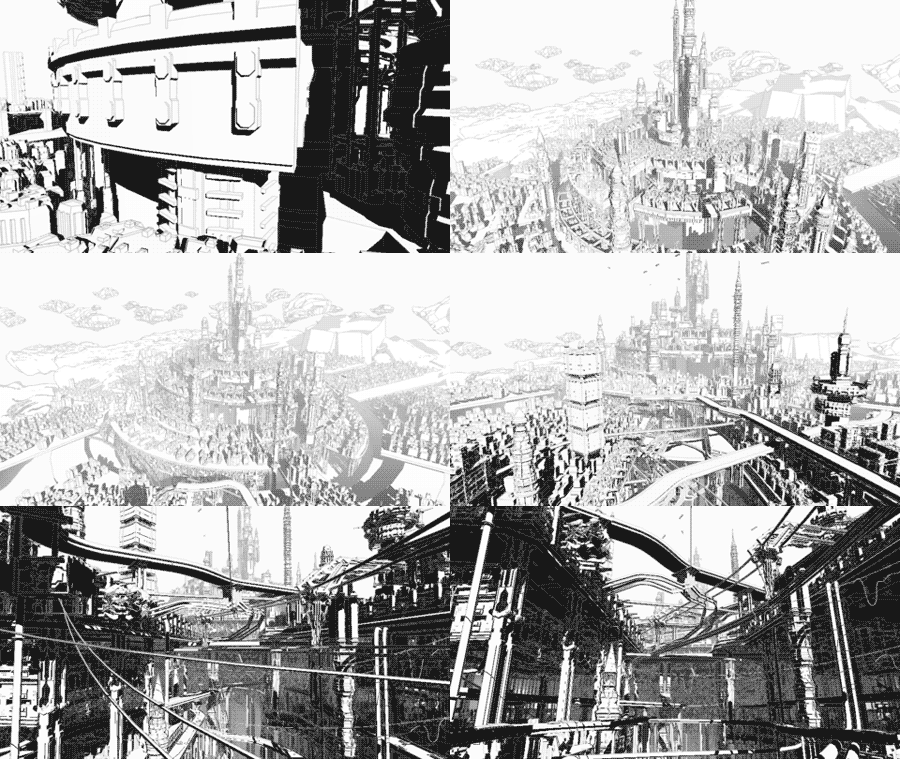
      Ammadhur was one of the first independent states formed after the Death of Gods. Refugees from all races came together in this sheltered coastal area and huddled for protection from the insanity raging across the world, and when things died down, they stayed, and built.  Ammadhur grew, and grew, and is now an immense urban sprawl, spread out over a stretch of coastline and a number of small islands - some natural and some artificial. It is positioned at a perfect natural harbor, in an area where a number of major ocean currents and major rivers happen to come together, and has thus become incredibly wealthy as a trade center and gateway to the interior of the continent.

Politically, Ammadhur is a representative republic. It is led by the Tyrant, almost always an elder merchant, head of one of the greater trading houses. The Tyrant is elected for life, via an incredibly complex system, designed to prevent favoritism or nepotism. Thirty members of the Great Council, chosen by lot, were reduced by lot to nine; the nine chose forty and the forty were reduced by lot to twelve, who chose twenty-five. The twenty-five were reduced by lot to nine and the nine elected forty-five. Then the forty-five were once more reduced by lot to eleven, and the eleven finally chose the forty-one who actually elect the Tyrant. While the system may seem impossibly burdensome, it has now been in use for almost 1000 years, and serves the city well.  The Tyrant has a fair degree of power in and of himself, but he is checked in many ways by both the Great Council and the League of Guilds, both of which groups are quite powerful in their own rights.

     The Tyrant is invariably shrewd, intelligent, and very very careful to keep the best interests of the City in mind. While he is elected for life, this comes with the loophole that a general vote of no confidence can result in his removal or execution at any time.  The traditional Tyrannical costume in fact comes with a noose which the Tyrant always wears, on the theory that it will keep him humble and in his place.

  Physically, the city is breathtaking. Immensely rich, the city is famed for its densely packed but beautiful architecture, between and among which flow thousands of canals, and nearly as many roads.  The city is also unusually multicultural, representatives of nearly every race and people can be found there, some keeping to their own neighborhoods and walled ghettos within the city, some intermingling. Peace is kept by a (typically for Ammadhur) complex system of watch forces, one answering to the Tyrant, one to the Counsel, one to the League, and smaller forces retained by the individual guilds and merchant houses.

     There actually remain several standing temples in Ammadhur. All are maintained by the city as museums, to remind the people of the death of gods, and it's effects on the world.  The names and faces of the gods have all been defaced from each temple.  The temple museums are all heavily guarded and protected by the enchanters' guilds and schools, as they are by their nature storehouses of powerful items of corrupted magic.

     Along with the merchant's guilds and various guard companies, the city is rife with other organizations vying for control. Competing thieve's guilds, mercenary companies, universities of magic, adventuring companies, etc.  Archaeological relic hunters undertake expeditions into the wild. Bounties on undead and on the gods' blood cults lead to professional hunters making hunting forays. Travelers' Societies work to keep the roads safe.

     Note that the various guard companies double as a standing army when necessary. On the rare occasion that Ammadhur has to go to war, the Tyrant takes overall control of all if the various guard companies, with the officers of those companies taking command roles in the resulting army. If necessary, the Tyrant may negotiate with the various mercenary companies that have their headquarters in the city.

     The wealthier sections of Amadhur have an alchemically powered commuter rail, streets lit by magic globes, high buildings with magically run elevators. The wealthiest have cars, electricity (for all intents and purposes), many or most of the modern conveniences. Middle class and higher have good medical care (some magical, some merely good care).

     The poorer sections of town of course have none of this, just a typical pre-enlightenment city. Little or no medical care, few conveniences, almost no available magical resources.

     The other side of the equation of course, is the danger inherent in the heavy magic use in the wealthier areas of town.  While all of the magical amenities and enchanted items are manufactured using the safesteans possible (which is in no small part why they are so imcredibly expensive), there have been problems in the past.   It was not all that long ago that the power in a simple light globe turned out to be ever so slightly corrupt, and slowly over the course of a few years caused several shopkeepers in the area to go mad, and ultimately die slowly and in horrible pain in the mage guilds' isolation cells, after each killed their loved ones.

Friday, February 24, 2012

Race: the Kin

Kin are short, wiry, and furry, with large slightly pointy ears and large sharp teeth.   They stand about 5 feet tall, with dark colored fur that ranges from gray to black to dark red or brown in varying patterns that are usually extremely subtle and faint, difficult to see unless one is very close.

Kin are extremely adaptable. They generally live in live in small troupes, and may be found in any and every possible environment, some in hidden enclaves in an around major cities. They are naturally stealthy and sneaky, with a fair amount of skill in magic.

Kin form close and intense relationships with groups of other Kin,  and they form what amounts to a simple telepathic or empathic connection with each other. This connection persists even when one Kin is corrupted by the Blood, and the changes expeienced by the corrupted Kin will actually pass through his bond to the others of his troupe. Thus, undead Kin almost always come in groups.  The bond itself does not appear to be magical in nature.

Note that undead Kin (Shadekin, to be discussed later) are almost indistinguishable from their living  brethren, save for being stronger both physically and magically, and with an uncanny ability to disappear into shadows and reappear elsewhere. Many Kin will in fact actively seek to fall to the blood purposely, and convert their troupe with them. The only physical difference between  a Kin and a Shadekin is that the patterns in their fur - which are subtle differences in fur color/shade and difficult to see under the best circumstance - will change so that they form mystical patterns and writing, which move and shift constantly.

It is assumed that the Kin have their own language, but if so it is a secret carefully kept from other races. Hence the fact that the race is named in the human tongue.

Race: the Sava

The Sava are a vaguely catlike people, and desert nomads.  They are long distance runners, hearty despite their thin and graceful builds, which is vaguely cheetah-like in basic form.

In their tongue, the word "Sava" means simply "family".  Sava as a rule are gregarious xenophiles who enjoy the company of other races, and famously will accept anyone into their families that can keep up with them, though of course very few actually can for any length of time.   They do not possess much technology, and have no magic at all, in part because they rarely hold still long enough to build much of anything, but mostly because the Sava are uniquely resistant to magic.

No Sava has ever been known to fall to the taint of the Blood, as far as anyone knows.  They actually seem to be oddly immune to the effects of the Blood, and in fact most forms of magic seem to just roll off of them. Especially strange is that members of other races who are welcomed into a Sava family seem to share some of the same resistance and immunity, at least for as long as they stay with their adopted family.  Even simply traveling with a group of Sava for a short time will convey at least some resistance to magic during that time. Note that the Sava resistance to magic is additive - the more Sava in the area, the greater their resistance, and it builds over time. A single Sava, with no family members in the area, will be somewhat resistant to magic, but much more vulnerable then she would be if surrounded by family.

Along with being gregarious, Sava are notoriously omnisexual, and possess no cultural sexual taboos. They usually do not form lasting sexual or romantic relationships, they are both culturally and biologically bisexual in nature, and they will generally happily seduce members of other races, of their own family members, or just whomever happens to be about.

Children are raised collectively by the family group, and form no particular attachment to their biological parents - they do not generally know who their biological parents are.

Sava family groups are named for a single individual who the family chooses based on factors that baffle outsiders, and seem at times to be an inside joke of some kind that outsiders will not get.

The Sava average between 5.5 and 6 feet, and are thin and wiry of build. Lightly furred, light earth tones in color with varying patterns. They will often dye wild and colorful patterns into their fur.

As unlikely a match as it may seem, the Sava and the Duer are very close allies.  The Sava insist that they taught the Duer to laugh and sing when they began to fall to their grief. The Duer differ, and say instead that the Sava were once more like them, but took the Duers' lessons in dealing with despair to ridiculous extremes.